
Amazon Leo, Starlink remain at loggerheads
May 11, 2026
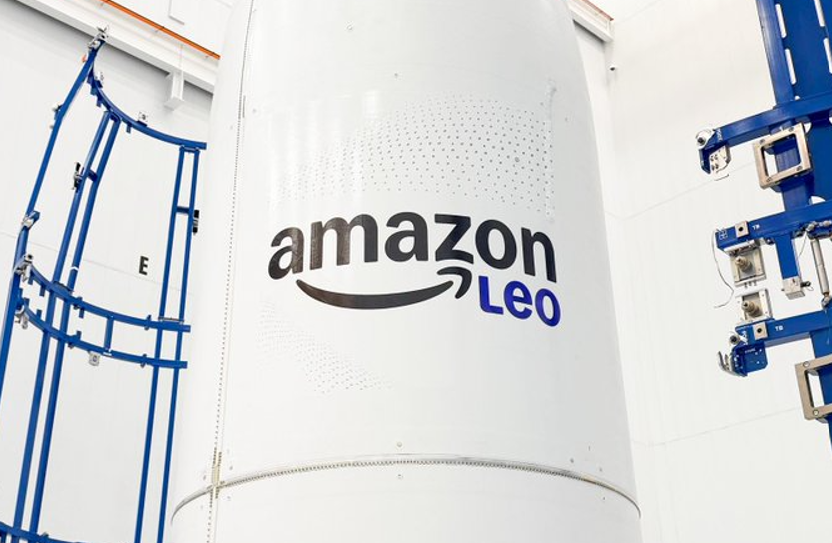
On April 30th an Arianespace 64 rocket delivered 32 satellites for Amazon Leo’s mega-constellation. All 32 satellites were deployed over 12 separation events lasting roughly 25 minutes in total and thus helping put the satellites into ideal orbital positions between 450 and 470 kms altitude.
That is too high, says SpaceX’s Starlink.
The launch provided another complaint from SpaceX (echoing that of a similar complaint on April 1st following a launch in February) that the satellites were above the FCC authorised heights which should be 443 kms.
Starlink operate most of their constellation at around 550 kms, but earlier this year announced that it would lower a portion of the constellation down to approximately 480 kilometres. At the time, Michael Nicolls, VP/Starlink engineering at SpaceX, explained that the lower orbit would “improve the safety of the constellation, particularly with difficult-to-control risks such as uncoordinated maneuvers and launches by other satellite operators.”
Amazon Leo is permitted to operate at 590, 610 and 630 kms. When launched, satellites are typically deployed into a lower orbit as on April 30th, with onboard propulsion systems used to raise them to their permitted operational altitudes. These on-board systems are also used for station keeping and collision avoidance.
In an April 2nd response, Amazon Leo stated: “SpaceX did not raise the issue during its first launch of Amazon Leo satellites in July 2025 to this altitude [460 kms], nor during two subsequent launches into the same insertion altitude. Nor did Amazon Leo conceal the change in its insertion altitudes from the Commission. In addition to explaining the change to Commission staff before making it, Amazon Leo has noted a mean insertion altitude of 450 km in multiple space safety reports filed with the FCC.”
In other words, SpaceX – which had handled an earlier launch for Amazon Leo in July 2025 – knew full well about the precise orbital insertions. Moreover, Amazon Leo says at the time of its first satellite launch SpaceX “had not yet begun meaningful reconfiguration of its [own orbital shells], meaning there were far fewer SpaceX satellites in the overlapping altitude band.”
Amazon Leo has now told the FCC that the most effective risk-reduction strategy is to lower insertion elevation (443 kms) below Starlink’s lowest shells after Ariane 6 insertion issues. This new approach will start with Ariane’s next flight and then follow on “with the majority of Amazon Leo’s remaining 2026 launches”.
Other posts by :
- Thailand’s National Telecom advised to give up satellite slot
- Moody’s issues Baa1 rating to SpaceX
- SES EGM approves corporate changes
- Reliance Jio promises LEO action for India
- China files for 244,000 satellites with ITU
- Analyst: SpaceX’s AI launch demands
- SpaceX: Day 2 shares at $192.50
- SpaceX: The verdict is in
- Russian satellites forcing European rethink