
Study: Europeans centre video habits around living room TV
March 25, 2026

RTL AdAlliance has released the fifth edition of its yearly Living Room Study, covering an even wider audience with new markets China and Hungary.
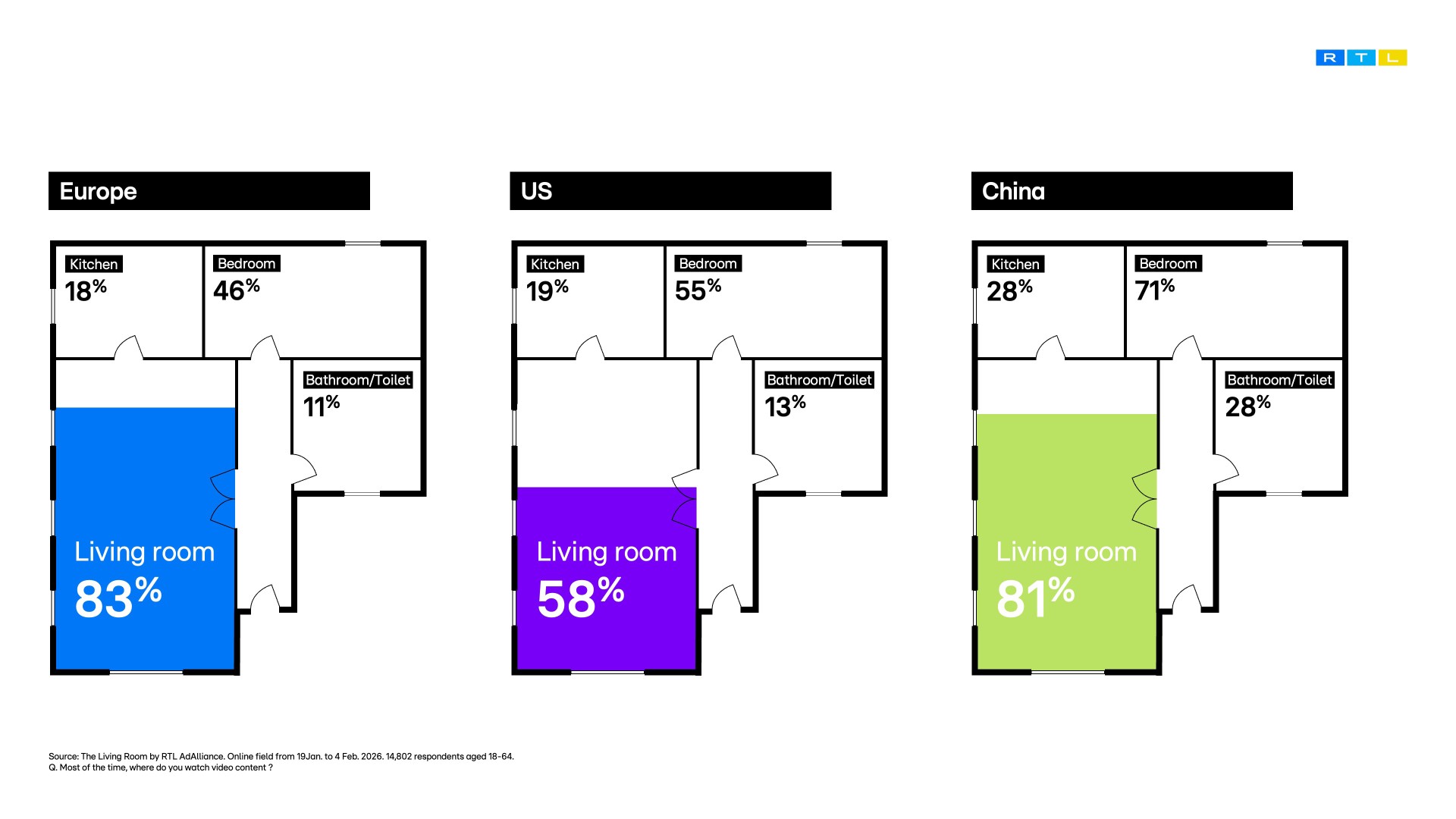
The research of RTL Group’s international sales house finds that the living room dominates viewing habits: a place where 83 per cent of Europeans most often watch video content, far ahead of the bedroom (46 per cent). In comparison with other markets, Europe indicates notable differences: Europe’s preference for the living room is 25 percentage points higher than in the US (58 per cent).
What began as a trend among younger viewers has now been embraced by every generation, the report shows. Streaming content once associated with mobile viewing is increasingly shifting to TV screens, where streaming has become widespread. Some 71 per cent use them at least once a week. BVoD has grown as a first destination on the TV set by six percentage points since the last edition and has reached 14 per cent, while 41 per cent of Europeans now watch live content through BVoD platforms on their TVs. Linear TV remains the top-of-mind destination on the TV set: 48 per cent of viewers tune in directly.
The contrast between Europe, the US and China reveals a distinctive media ecosystem shaped by decades of local broadcasting, free-to-air access and strong cultural proximity. Europeans turn to global streaming platforms mainly for on-demand content, while live events, local programmes, and shared viewing moments remain rooted in linear TV. This environment – the trust, the consistency and the audiences who show up and stay – is not something a platform can manufacture through pure scale or spend, The Living Room Study revealed. Nearly two-thirds (61 per cent) of the respondents trust linear TV first when seeing an ad, far above social media (33 per cent) and YouTube (40 per cent).
At the same time, audiences recognise the increasing fragmentation of the video landscape: Audiences are splitting across platforms, attention spans are shrinking and long-form content is being carved into clips for feeds that reward speed over substance. A trend dominant in the US and China, but less pronounced in Europe, where long-form formats remain more resilient. However, social media and television do not operate in isolation: 39 per cent of Europeans aged 18 to 34 watch programmes on television that they first discovered on social platforms while 67 per cent discuss on social media what they have seen on TV. But social media is losing its appeal for genuine connection and users start to look for shared experiences elsewhere. Three-quarters (74 per cent) of Europeans say social media has lost its ability to create real social connections, the highest level among the regions studied (72 per cent in the US, 59 per cent in China).
Stéphane Coruble, CEO at RTL AdAlliance, commented: “The living room is not losing ground in Europe; it is gaining relevance. Europeans watch video on fewer screens, spend longer with what they choose, and protect formats that other regions have already fragmented. The contrast against markets such as the US and China is striking, and it points in the same direction: what Europe has built around its main screen has no equivalent anywhere else in the world.”
Other posts by :
- SpaceX: IPO offer in days?
- Forecast: SpaceX tracking to $20bn revenue in 2026
- EchoStar’s Dish restructures debt obligations
- AsiaSat hits Zee and JioStar with legal actions
- Nvidia unveils orbital chip/computer for AI and data
- Space Sector: ‘Profound Acceleration in 2026’
- Starcloud wants 88,000 satellites
- Lynk Global requests “experimental” satellite access