
Nvidia unveils orbital chip/computer for AI and data
March 18, 2026
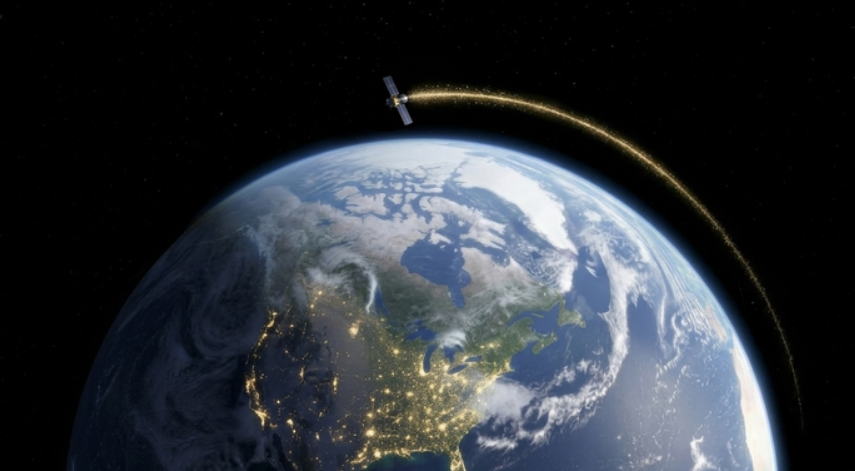
Tech giant Nvidia has revealed that it is working on a suite of new chipsets which will be combined with a processing computers for use in space and orbiting data-centres.
“It’s going to start data-centers out in space. Of course, in space there’s no conduction, no convection, there’s just radiation, so we have to figure out how to cool these systems out in space, but we got lots of great engineers working on it,” said President/CEO Jensen Huang speaking at the GPU Technology Conference in San Jose, California.
He said the core chipset, called ‘Space-1 Vera Rubin Module’ will deliver data-centre-class performance and edge AI inferencing for orbital data centers, geospatial intelligence and autonomous space operations.
Nvidia said that it was working with Aetherflux, Axiom Space, Kepler Communications, Planet Labs PBC, Sophia Space and Starcloud which are using Nvidia accelerated computing platforms to power next-generation space missions.
“Space computing, the final frontier, has arrived. As we deploy satellite constellations and explore deeper into space, intelligence must live wherever data is generated,” said Jensen Huang, founder and CEO of Nvidia. “AI processing across space and ground systems enables real-time sensing, decision-making and autonomy, transforming orbital data centers into instruments of discovery and spacecraft into self-navigating systems. With our partners, we’re extending Nvidia beyond our planet — boldly taking intelligence where it’s never gone before,” said Huang.
Nvidia’s partners also supplied more background to the news.
Baiju Bhatt, founder and CEO of Aetherflux, commented: “At Aetherflux, we’re pioneering a new paradigm for power and compute in space. Nvidia Space-1 Vera Rubin Module delivers high-performance, energy-efficient AI at the edge in orbit, powered by solar energy. This enables autonomous operations and mission-critical services, and unlocks scalable, space-based AI infrastructure beyond Earth.”
Mina Mitry, CEO of Kepler Communications, said: “Kepler Communications is building the next-generation data network that enables real-time connectivity in space. Nvidia Jetson Orin brings advanced AI directly to our satellites, allowing us to intelligently manage and route data across our constellation and turning our network into a smarter, more efficient platform that reduces latency and delivers secure, reliable connectivity at global scale.”
Will Marshall, cofounder and CEO of Planet, stated: “Planet images the Earth every day, a data challenge that requires the world’s most advanced computing. By integrating Nvidia’s accelerated platform from space to ground, we are supercharging our ability to index the physical world. Using Nvidia CorrDiff AI models, we are moving from raw pixels to actionable insights in near real time. Together, we are enabling a revolutionary leap in planetary intelligence, helping humanity make smarter decisions at the speed of global change.”
Rob DeMillo, CEO of Sophia Space, said, “Sophia Space’s focus is on building modular, passively cooled, hosted computing platforms that give customers dedicated infrastructure to run applications directly in space. Nvidia Jetson Orin enables us to embed AI capability into that infrastructure, supporting real-time processing and autonomous operations within strict size, weight and power constraints. This brings cloud-like flexibility to space and makes orbital computing commercially accessible.”
Philip Johnston, CEO of Starcloud, added: “Starcloud is building purpose-designed orbital data centres to deliver cloud and AI infrastructure directly in space. With Nvidia, we can bring true hyperscale-class AI computing to orbit — processing data at the source, reducing downlink dependency and enabling customers to run training and inference workloads in space for the first time. This is a critical step toward making space a seamless extension of the global cloud.”
Other posts by :
- Space Sector: ‘Profound Acceleration in 2026’
- Starcloud wants 88,000 satellites
- Lynk Global requests “experimental” satellite access
- Safran Space links laser direct to satellite
- SpaceX fearful of AST SpaceMobile’s potential?
- Equatys wants 2,800 new satellites
- FCC eyes freeing up Weird Space Stuff spectrum
- SES happy with releasing 160MHz of spectrum for 5G
- Inmarsat “likely to win appeal” over Ligado/AST action