
Eutelsat: “IRIS2 comes at critical moment for Europe”
January 29, 2026
By Chris Forrester
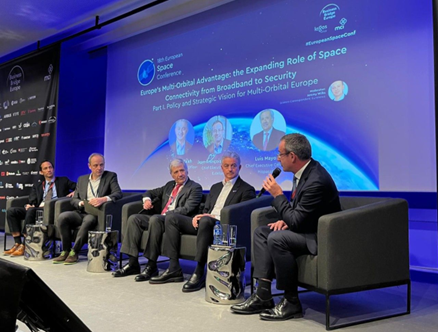
Jean-François Fallacher, speaking at the European Space Conference, said that the IRIS2 highly-secure satellite constellation was the result of years of work and came at a “critical moment for Europe”.
He told delegates that the project had a clear objective: “To provide Europe with its own next-generation satellite capabilities – autonomous, resilient, and delivering its first high-quality services in 2029. This timeline is not optional. Europe must now unite behind IRIS² to turn ambition into operational reality, with competitive infrastructure from day one.”
“From a capability standpoint, one point is clear: LEO is essential. Low latency, resilience, and global coverage are now core requirements for commercial customers and governments, especially in highly strategic regions. The strong growth of government revenues from our OneWeb LEO constellation confirms this. Since 2021, Eutelsat has been operating LEO at scale, and we are putting this proven expertise into IRIS² to build the future of our European Constellation,” he said.
Perhaps hinting at the position in Germany where its army is developing its own military satellite connectivity, he cautioned: “Europe must avoid fragmentation. The multiplication of constellation projects is not the right path – spectrum is limited, funding is constrained, and a collection of projects would weaken Europe just as our global and giant competitors accelerate. Focus, consolidation and scale are essential.”
“IRIS² is more than a space programme. It is a demonstration of Europe’s unity and credibility. Timing is a decisive success factor. The moment to act is now. With our partners SES Satellites and Hispasat, Eutelsat is driving the SpaceRISE consortium and is fully committed to support European Commission in delivering first IRIS² services in 2029: for Europe, with Europe,” he added.
The meeting also heard from the EU’s Commissioner for Defense and Space, Andrius Kubilius, who talked about other third-party states joining IRIS2 and had specifically referred to Norway and Iceland. According to an interview with Euractiv, he said: “I would not be opposed.” He noted that the UK has a well-established track record in space technologies, while Ukraine offers considerable potential, having been a major space hub during the Soviet era.
However, responding from the UK, Chris Bryant, the UK minister for science, said it would be a financial stretch for the UK to join IRIS2. “IRIS² is unlikely to be high up the list of priorities, he told the UK’s pariament. “It is going to be quite a stretch for us to get to our existing commitments, let alone to add new commitments, financially.”
Other posts by :
- IRIS2 free for government usage?
- Bank: AST SpaceMobile will orbit 356 satellites by 2030
- SpaceX launches 600th rocket
- Starlink: 10m customers and counting
- SES predicts end of ‘big’ Geo satellites
- Amazon Leo gets approval for 4,504 extra satellites
- SpaceX gets a portion of India
- TerreStar wants to build LEO network
- Musk: “No Starlink phone”