
Survey: Audiences’ top AI concern is blurred reality
January 15, 2026

In an era when artificial intelligence (AI) is increasingly woven into creative pipelines, the question of how consumers feel about AI’s role in entertainment has moved from speculative to urgent.
A survey from Hub Entertainment Research finds that while consumers increasingly expect AI to reshape everyday life, their acceptance of AI in entertainment depends heavily on how – and how transparently – it is used. Key findings from Hub’s AI and Audiences survey fielded in Q4 2025 include:
AI is moving mainstream, and quickly.
· Three quarters (72 per cent) feel at least somewhat familiar with generative AI and how it works.
· The same number (73 per cent) say they used generative AI tools in 2025, up from just 57 per cent in 2024.
Consumers are most enthusiastic about AI when it improves the viewing experience
· Almost half (49 per cent) think that generative AI will be good for society – 2x the number who think it will be bad, and up from 44 per cent in 2024.
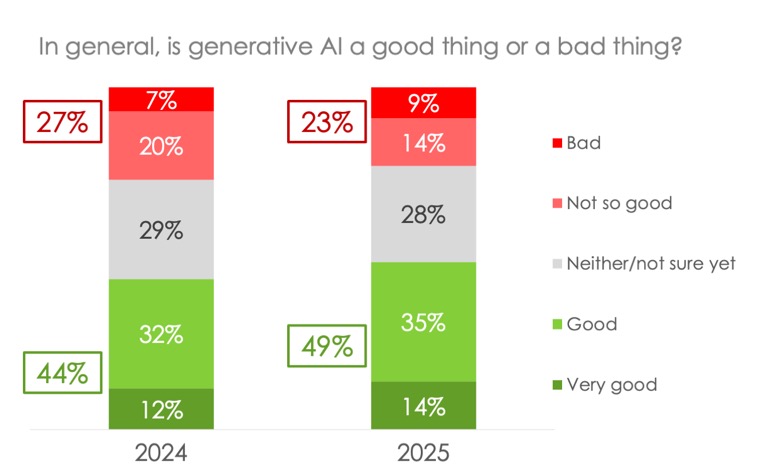
But that positive reception varies widely depending on the use case.
The strongest excitement centers on AI-powered discovery, such as smarter recommendations or conversational tools that help viewers decide what to watch next. These uses position AI as a guide that makes entertainment easier to navigate, rather than a tool that fundamentally alters creative output.
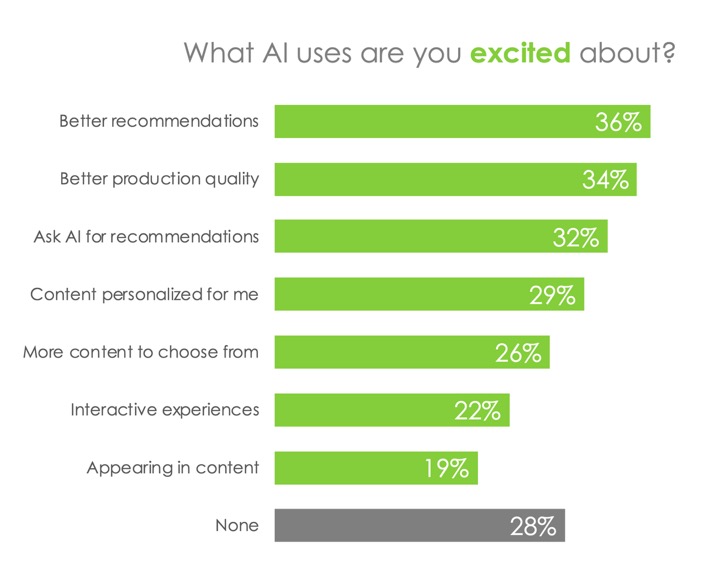
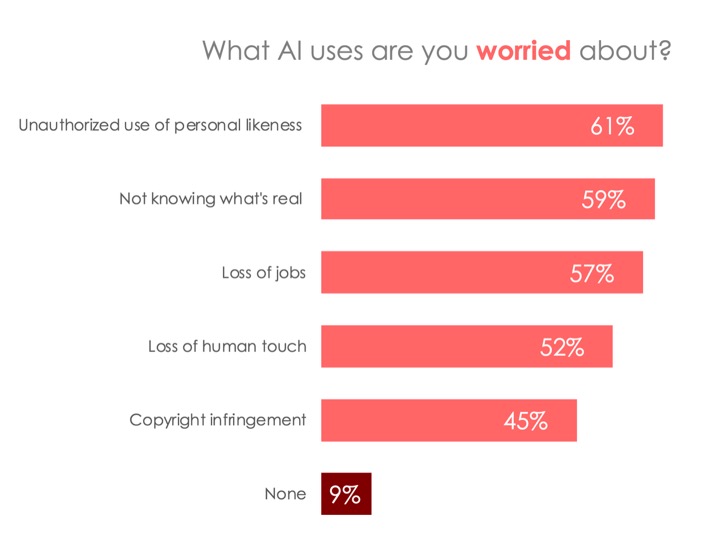
Respondents are most uncomfortable when AI blurs the line between reality and artificial content
Consumers’ greatest concerns are around being misled by AI-generated content or losing the ability to distinguish what is real.
This discomfort extends to AI-generated actors and performances, even among those who are otherwise comfortable with AI – underscoring the importance of trust and authenticity in entertainment.
In fact, 72 per cent say that companies should always disclose if AI was used in any way to make content they’re watching and another 21 per cent say companies should disclose if AI played a major role in content creation. Only 7 per cent feel like no disclosure about AI is necessary.
Respondents are suspicious of companies using AI to generate revenue.
· 40 per cent say they are “completely comfortable” with AI being used by “regular people for personal reasons.” That’s roughly 2x as many as those who feel the same about influencers or companies using AI for commercial purposes.
One big potential area of opportunity: AI that enables users to create their own content.
· Hub asked respondents if they’d be interested in an AI application that enables them to create their own stories and videos using Disney IP and characters. (Note: This study was conducted approximately two weeks before Disney and OpenAI announced a partnership to deliver this exact use case).
· Among consumers who consider themselves familiar with AI, almost half (44 per cent) were “definitely” or “very likely” to use this feature. Another 24 per cent said they might try it.
“Consumers have shifted significantly since last year when it comes to familiarity, usage, and optimism for AI,” commented Jon Giegengack, Principal at Hub and one of the study authors. “The positive reaction to user-generated content using Disney IP reveals maybe the biggest opportunity: enabling media companies to turn audiences into participatory communities. Until now, this has been the domain of companies like TikTok, Roblox or Fortnite.”
Other posts by :
- Bank: “SpaceX should lobby for an MVNO”
- New Glenn amends pre-launch methods
- Iridium deal a “watershed” moment for Rocket Lab
- S&P adds Arqiva to CreditWatch negative list
- Bank: The AWS-3 winners
- Analyst: SpaceX and its cellular plans
- Vodafone Spain explains Sat-Connect Europe plan
- FCC praises AST SpaceMobile