
NHK Labs succeed with OLED blue light
January 22, 2026
By Chris Forrester
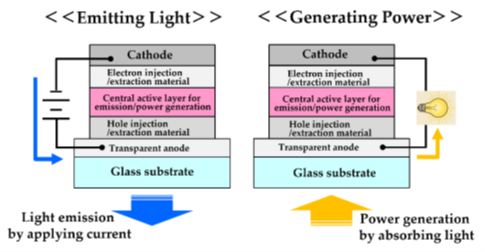
NHK’s Science & Technology Research Laboratories (STRL), in collaboration with Professor Hirohiko Fukagawa of Chiba University’s Advanced Science Center and Professor Takuji Hatakeyama of Kyoto University’s Graduate School of Science, has successfully developed the world’s first organic LED display device capable of blue light emission while also generating power. The research was published in the renowned academic journal Nature Communications on January 20th.
Traditionally, light emission—turning electricity into light—and solar power generation—turning light into electricity—are opposite processes, making it extremely difficult to integrate both functions into one device. However, the team succeeded in creating a display element that can alternate between emitting light and generating electricity; moreover, they achieved world-leading levels of both luminous and power-generation efficiencies, delivering a major breakthrough, say the team.
This pioneering development was achieved by using MR-TADF materials that combine high luminous efficiency for light emission and strong light absorption for solar power generation, and by precisely controlling energy within the device. For display applications, the research team achieved red, green, and blue emission, with blue emission marking a world-first for a dual-function device, and therefore, enabling emission of a wider range of colours.
MR-TADF stands for Multiple-Resonance-Type Thermally Activated Delayed Fluorescence, and these materials feature a structure in which atoms such as boron (B) and nitrogen (N) are alternately arranged at specific, well-defined positions. They exhibit high luminous efficiency and excellent colour purity, and have already been commercialized as advanced materials for OLED applications. The adoption of this MR-TADF material as one of the central active layers was the key to this breakthrough.
Speaking on behalf of the development team, NHK researcher Taku Oono said: “During the Great East Japan Earthquake, many people evacuated to places like school rooftops. Over time, they lost access to critical information because there was no electricity. Although NHK broadcasted vital updates, some of the people who needed them most couldn’t receive them. In the future, we hope this technology can be applied to devices such as mobile screens, so that even in places without electricity, everyone can access the information they need.”
Building on this vision, the team is now focused on advancing the technology itself—improving efficiency and durability for both light emission and power generation. These enhancements will pave the way for practical applications such as low-power displays. Looking ahead, a display equipped with power-generation capability could reuse electricity generated by its own screen, enabling video playback even in environments without external power sources, such as during disasters.
Other posts by :
- SES to FCC: “Don’t auction more than 160 MHz of C-band”
- Morgan Stanley downgrades Iridium
- SpainSat-NG II a total loss
- SES warns of risks for airlines adopting Starlink
- Starlink facing backlash in South Africa
- China wants 200,000 satellites
- Bank raises view on AST to $100
- Frost & Sullivan cites Hughes as #1
- Verizon cutting prices