
Data: Digital entertainment spend up 7.1% in 2025
March 4, 2026

Digital entertainment and retail association ERA has published the 26th edition of its annual yearbook detailing the progress of the music, video and games sectors in the UK in 2025.
It builds on interim figures released in January which showed the sector achieved revenues of £13.3 billion (€15.2bn) in 2025, up 7.1 per cent, meaning it grew four times faster than the wider UK economy.
Key findings include:
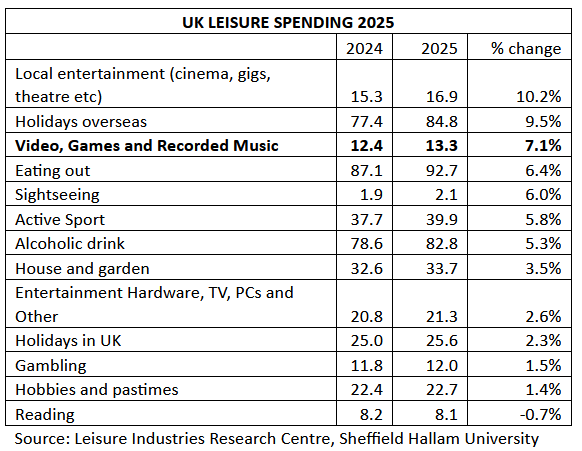
The ERA Yearbook contains latest data from Sheffield Hallam University’s Leisure industries Research Centre which offers an overview of UK leisure spending and shows that in 2025, digital entertainment sales grew faster than every sector apart from ‘local entertainment’ (cinema, gigs, theatre etc) and overseas holidays.
With growth of 7.1 per cent the music, video and games sectors outstripped books, magazines and newspapers (down 0.7 per cent), gambling (up 1.5 per cent), alcohol (up 5.3 per cent) and eating out (up 6.4 per cent).
ERA CEO Kim Bayley, commented: “Entertainment’s 7.1 per cent growth in 2025 was certainly above expectations, but these new figures show that in the context of the broader leisure sector 2025 really was a banner year for music, video and games. This reflects the changing role of entertainment in the streaming age from treat or gift to everyday necessity with, for example an average of 2.9 video subscriptions per person.”
Bayley pointed to figures which show the average consumer in the UK watches 17.6 hours of film and TV, listens to 12 hours of music, plays 8.9 hours of games, and listens to 3.8 hours of podcasts every week.
“This is dramatic evidence of the ubiquity of entertainment,” Bayley added, “It means people in the UK now spend over a third of their waking hours engaging with entertainment.”
Music fighting back on the High Street
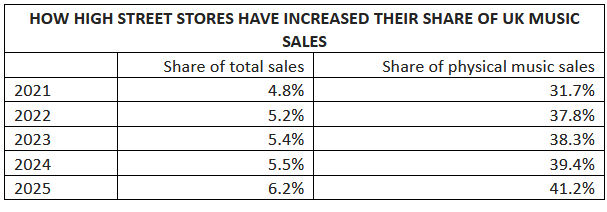
ERA research shows physical record shops continuing to grow in strength driven by the growth in vinyl sales (now at an 18-year high). While home delivery continues to account for more than half of physical music sales, bricks and mortar stores have increased their share by nearly a third since 2021 to 41.2 per cent. They have increased their share of total music sales (including streaming) to 6.2 per cent over the same period.
Increasing demand for vinyl from millennials has led to growth for the UK’s only national music retail chain HMV, now with around 120 stores, and has led to a spurt of independent store openings. The total number of independents increased to 499 in 2025 – up 28 on the year.
Bayley said: “Record shops are proving they can compete and prosper by doubling down on vinyl and by attracting a new generation of buyers attracted by the IRL (in real life) experience. Shops have reinvented themselves to become cultural hubs on the High Street, offering live performances – around 4,000 of them last year – and an immersive experience the internet cannot match.”
But Bayley warned that increasing business rates and other costs now threaten that resurgence. “Record stores have created this success without any help, reinventing themselves as cultural anchors on the UK’s often dismal High Streets. There’s a real fear that without relief this raft of unwelcome new costs could throw their renaissance into reverse.”
Other posts by :
- FCC seeks fair play over foreign satellite access
- Bank raises RocketLab target price
- Ukraine wants its own LEO system
- SpaceX outlines Starlink cellular delivery plan
- NAB vs CTIA on C-band release
- Laser terminals to operate at 100x faster
- Starlink success in Spain, but South Africa proves difficult
- RocketLab doubts over Mynaric bid