
Second screen viewing – current habits & behaviour
February 17, 2026
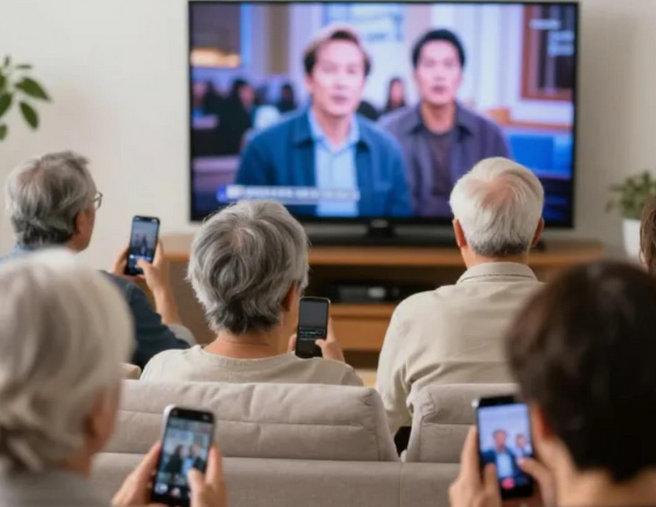
What are TV viewers using the second screen for? Discover how social media, messaging, contextual searching & online shopping are reshaping television experiences.
Second-Screen Culture: What People Do While Watching Live TV
We stopped watching Live TV in the same way we did before. Have you noticed this: you turn on a movie or a match, and your smartphone is already active? Recent studies show that 86 per cent of audiences do it. We can reply on Messenger, scroll through TikTok or do online shopping, and so on. This phenomenon already has a descriptive term: second-screen viewing. Let’s see why one screen is not enough and what people do while watching TV in most cases.
The Roots of Multitasking While Watching TV
The practice of doing something else while watching Live TV is not new. Speaking precisely about ‘second screening’, it’s slightly over a decade old. Psychologists explain that the multi-layered experience of content consumption originated from human desire for a quick dopamine rush. This is multiplied by the technical ability to avoid being limited to linear, concentrated viewing.
The parallel use of different platforms doesn’t interfere with watching. Consequently, this viewing becomes background-oriented, and as soon as something uninteresting happens on the main screen, people can switch to the second one.
The third reason for the prevalence of multitasking while watching anything is the desire for personalisation. We want to manage our own time as we like, without restrictions.
Who’s Glued to the Second Screen More?
We dug and found that second-screen culture doesn’t just embrace young viewers. Over 85 per cent of Gen Z representatives scroll through social media while watching something. Older people are less prone to this, while over 75 per cent of Millennials also share the habit.
Which Second Screen Habits are Taking Over
To maintain engagement, a show must keep the plot highly dynamic, vary visuals, and use different angles and scales. While this is easily achievable on TikTok, it is often not feasible in a TV show format. Consequently, the audience’s attention wanders, and they seek an extra dose of dopamine or information on a second screen.
Digital Entertainment Viewers often choose casual games or poker apps available in the UK, which adds an emotional element to their relaxation. Among second-screen activities, mobile gaming ranks second to messaging. Younger audiences launch Roblox, Fortnite or shooters. Gen Z and Millennials opt for charades, puzzles and long-time favourites, such as Plants vs Zombies, Subway Surfers, etc.
Contextual Searching
Many viewers look up additional data about what they are watching. People dive deeper into someone’s bio, trying to figure out more interesting facts about a familiar star. They often look up plot intricacies, director explanations, and filming locations.
TV viewers don’t want to limit themselves to passive observation; they quickly seek answers to any questions they have while watching. So, enjoying favourite movies has become interactive. People are specifically interested in:
● Rumours about the lead actors.
● Their comments regarding the movie or series.
● Leaks of plot details for unreleased episodes.
The release of Stranger Things Season 5 was accompanied by a surge in Google searches for ‘actor interviews’, ‘director’s cut’, and similar queries. And such examples are numerous.
Impulsive Online Shopping
Some TV channels utilise distracted viewing to improve advertising integrations. QR codes may appear on the screen, redirecting the person to make an instant purchase. Similarly, promo codes and discounts on decor, furniture, clothing, or gadgets shown by hosts on various shows are effective. Statistics show that purchases of kitchen appliances and signature spices skyrocket during cooking shows, for example.
Messaging and Checking Social Media Dominate
Many viewers, especially among Gen Z, check messages within 60 sec of receiving them. Texting and chatting with their family and friends becomes a way of building communities – that’s how they engage. They have grown up with smartphones in their hands, so it is no surprise they gravitate towards messaging at all times, even while watching TV.
No less surprising is that Gen Z makes up a big part of social media users, along with Millennials. Instagram, Facebook, TikTok and Snapchat are among the favourites. But scrolling through feeds doesn’t mean that whatever happens on the TV screen is boring. Social media and messengers are often the perfect way to fill the gap during commercials. Smartphones are always at hand, and social media is optimised for short sessions – that’s a combo.
People behind TV shows are well aware of this tendency. Smart ones keep audiences engaged by posting short clips, images and quotes on social media. During the show. To keep you in.
Social TV – A Response to Modern Needs
The freedom to choose what and how to watch has led to the emergence of social TV. Here, the viewer is not passive. They can watch the main content on TV while commenting, voting, and participating in polls on social media. People become active participants in the broadcast without being stars or influencers. They vote for contestants in the Eurovision selections or instantly share their impressions of what they are viewing.
Viewers also:
● Take part in live discussions on X (formerly Twitter) and Reddit.
● Adore YouTubers’ reactions and show reviews.
● Share the funniest moments and memes on TikTok/Instagram.
Second-screen viewing couldn’t go unnoticed. Content creators now adjust to new realities and offer real-time engagement through polls and reactions. They script TV shows and add spicy topics to spark immediate online conversations.
Is Second Screen Viewing Our New Norm?
Second-screen viewing is no longer a trend or a side habit – that’s our new reality. Experts are unanimous in the belief that synchronous interaction is not a sign of disrespect toward the content on the primary screen. Rather, it is a way to make leisure time more engaging and fulfilling. While so, this new norm is changing how TV shows get made.
However, neuroscientists are concerned. Constant usage of two screens may lead to attention fragmentation, overstimulation and fatigue. Sometimes, setting aside multitasking to focus on a single screen can be a good idea, they say.
Other posts by :
- Virgin Galactic sets prices for space tourists
- Devas vs Antrix rumbles on
- Shotwell makes TIME front cover
- Suitors eye Globalstar
- SpaceX: IPO offer in days?
- Forecast: SpaceX tracking to $20bn revenue in 2026
- EchoStar’s Dish restructures debt obligations
- AsiaSat hits Zee and JioStar with legal actions